Romeo and colleagues, 2018
[3]Harvard University and MIT
- Who
- 36 children aged 4 to 6 in the United States, recorded at home.
- Found
- More conversational turns with adults went with stronger verbal skills. This shows a link, not a cause.
Language learning and enrichment for children aged 3 to 12
Learning by engagement, not entertainment. Clever Bear is a story world your child explores: a picture book, and an activity book set in the same places with the same friends. Your child hears the words, finds them and uses them where the story happens. Every activity teaches; nothing is there just to keep your child on the screen.
Clever Bear is an iPad app. No card for the first book, which is in English. Membership is one monthly payment.
HarvardMITCambridgeLeidenMcGill
Research from these universities and others, 20 published studies in all, shaped how Clever Bear is built. Every one is linked at the foot of this page.
The problem, and the evidence
I wanted them to learn it quickly. I did not want it to feel like a chore.
So I looked at what an iPad could give them. What I found was mostly games that were loud and overwhelming, with a little learning added, and stories that felt made in a factory: bright, fast and soon forgotten. I could not find anything that grew a child's language through thoughtful play.
So I stopped looking at apps and started reading the research. How do children really learn a language? What makes new words stay? What does play add, and when does it get in the way?
The answers were clear enough to build on. Clever Bear is the method we built from them.
— The founder of Clever Bear, and parent of the twins
It is not just our experience
A 2022 University of Michigan study looked at the three apps each of 160 children aged 3 to 5 used most. Designs that push children to keep playing, or to pay, were common: nearly half the apps used lures to keep them playing.20
We read the studies before we built anything. They come from universities including Harvard, MIT, Cambridge, Leiden and McGill. Here is each one in plain words: who was studied, and what was found. Each number links to the study.
Harvard University and MIT
McGill University
University of Alberta
University of Canterbury
Florida State University
University of Sussex
Temple, Delaware, Vanderbilt and Lehigh universities
University of Stavanger, with Eötvös Loránd, Sheffield and the Open University
University of Cambridge
University of Guelph
National Taiwan Normal University
Leiden University
Leiden University
The Clever Bear method
It is a method, not a story with a game attached. Five steps, each from research, and each one shaped what we built.
Children pick up a language from what they hear and use around them. In a study of 5-year-olds in Montreal learning French and English at once, the more a child heard a language, the bigger their vocabulary in it.1 Among 169 children aged 5 to 7 learning English as a new language in Canada, longer and richer contact with English went with more English words and grammar, though each child's own aptitude mattered even more.2 And children aged 4 to 6 who had more back-and-forth conversation with adults had stronger language skills.3
So we never teach a word on its own. Every word arrives inside a place, a moment and a reason to say it.
Stories carry a great many words, in a setting that makes them mean something. In one study in rural Fiji, pupils aged about 9 to 11 whose classes were given 250 illustrated English story books made more progress in English reading and listening over eight months than matched classes without them.4 Across 54 studies of young children learning English, reading books together with an adult had a positive effect on their English.5 And 3-year-olds kept new words when they heard the same story again, but not when they met the same words in different stories.6
So each book is a real story with characters children care about, made to be read again and again. The words a child can use this week are the ones the story leans on.
In a study of 249 preschool children, playing with toys from a story after it was read helped them learn the story's words, and they learned more when an adult guided the play.7 A 2025 review of 20 studies with 1,978 children found that actions matching what a story's characters do helped children understand the story, while mini-games did not.8 At Cambridge, Samantha Hulston studied "curated storyworld play": play built from a story children know, with 4- and 5-year-olds in their classrooms.9
So every activity is built from the book, with the same friends, and every one does a language job. Your child hears a word at the moment they do the thing it names.
Young children rarely look at the words while a story is read to them: less than 2% of the time, in a study of 76 children aged 3 to 5.10 When each word lit up as it was read aloud, 4- and 5-year-olds looked at the words twice as much (from 19% to 38% of the time, in books where words and picture had equal space).11 Across 43 studies, animated pictures, music and sound that fit the story helped understanding and vocabulary, while hotspots and games inside the story distracted.12
So the words in our books are real printed text, never part of a picture, and nothing to tap interrupts the story. A read-aloud voice lights up each word as it is spoken.
In the free first book
All of this is in the free first book, London.
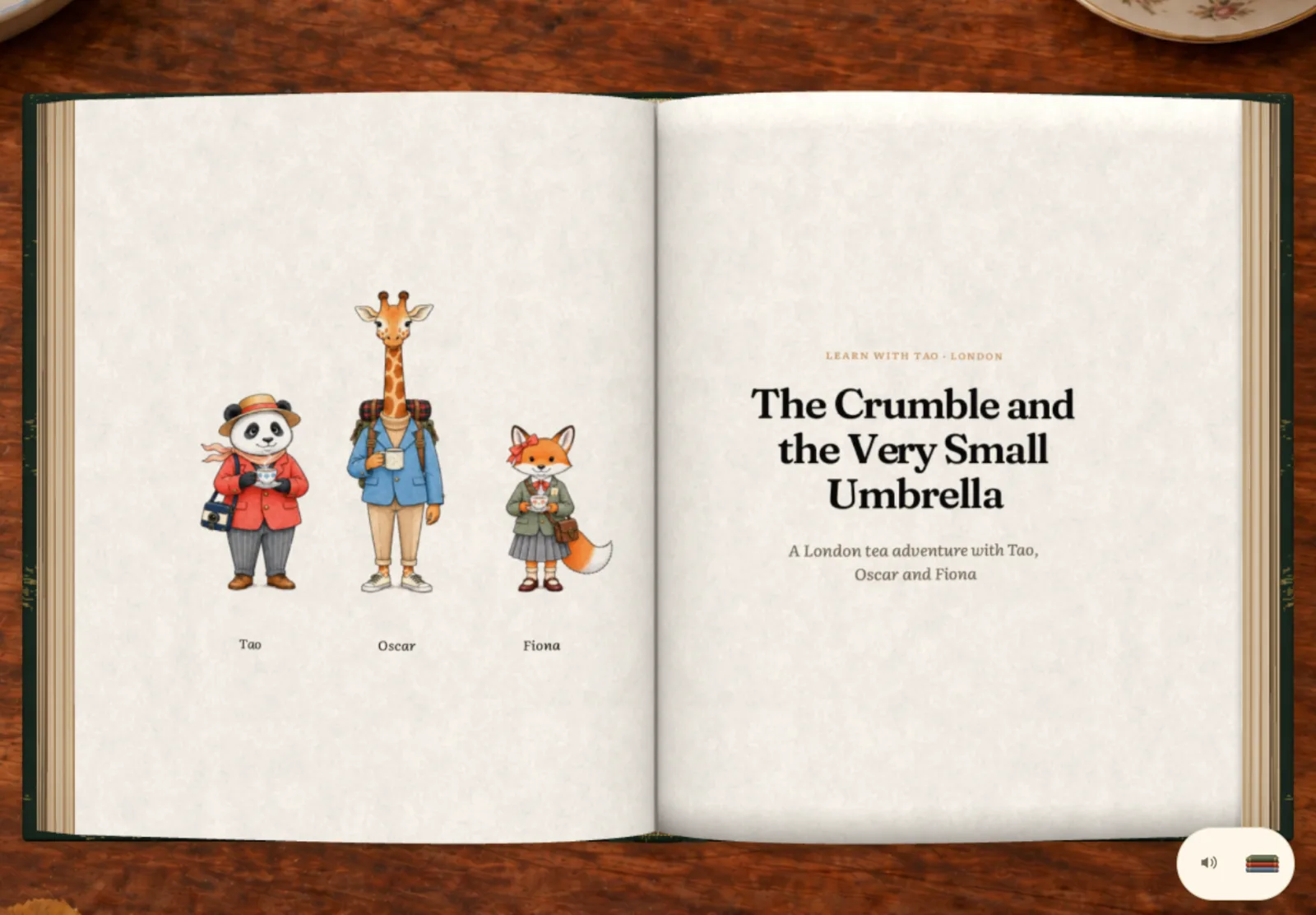
A picture book that opens like a real book. The pages turn under your child's finger.
Meet the words inside a story worth caring about. Read it together, or let it read itself aloud, word by word.

Tap a place on the map to hear its name: Big Ben, Tower Bridge, the River Thames and 13 more.
Hear a name and match it to a place.
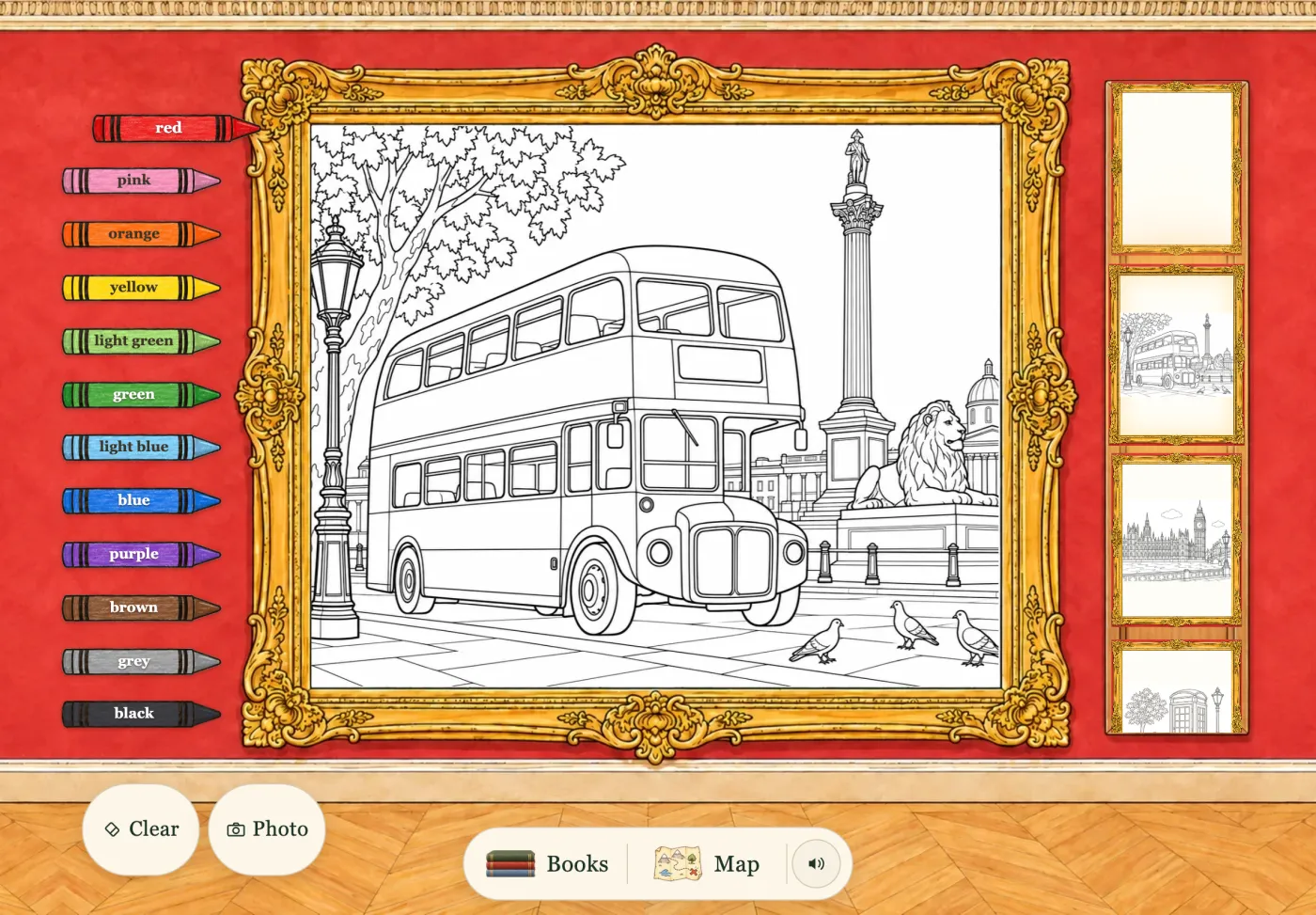
Pick a crayon and hear its colour: red, yellow, light blue and 9 more. Colour a bus, a phone box or a teapot and hear each one named.
Colour words and the names of everyday things, heard at the moment of choosing.
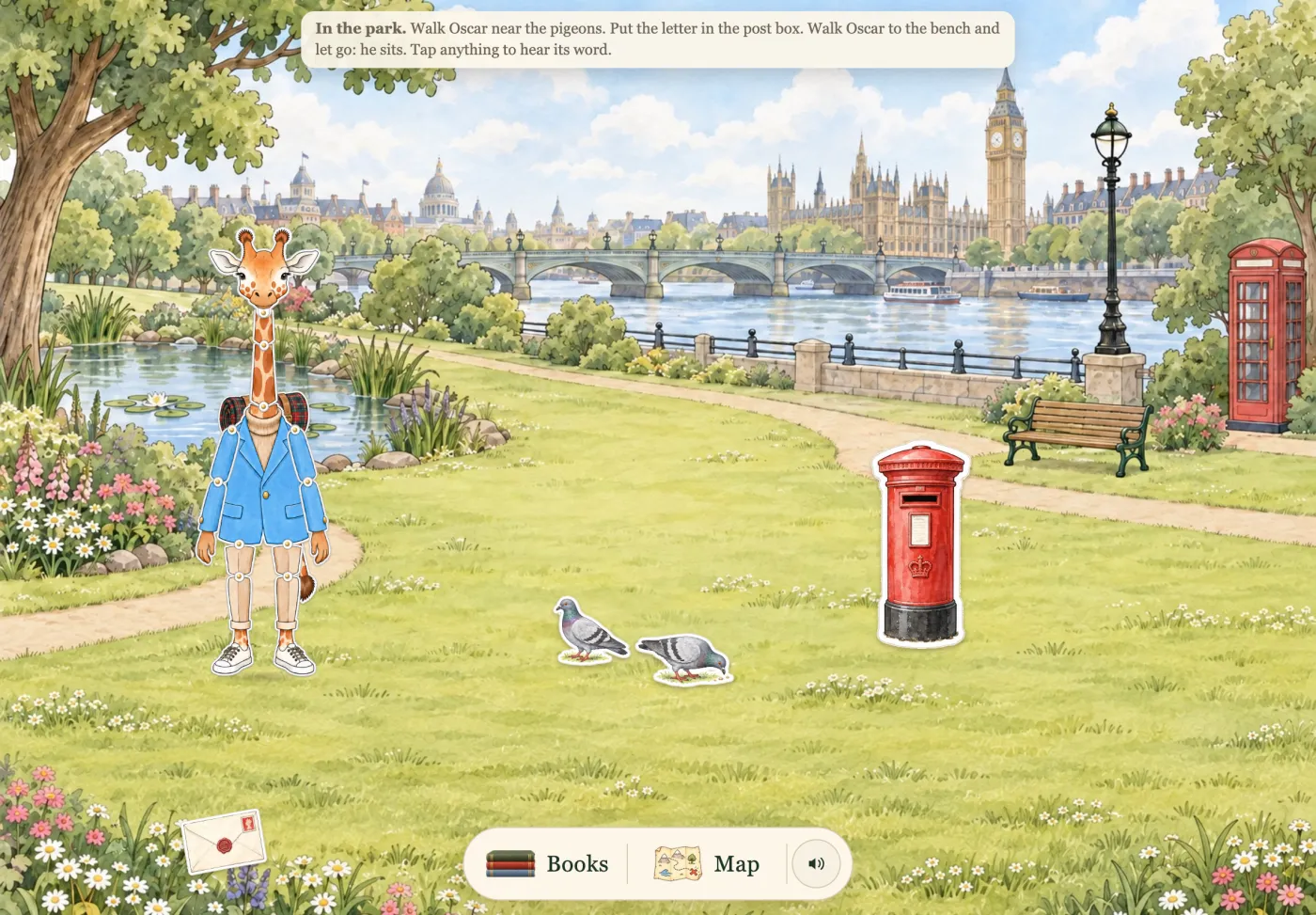
Walk Oscar to the bench and he sits. Post the letter in the post box. Walk him near the pigeons and they fly away.
Action words, heard while your child makes the action happen. Six-year-old beginners who listened and acted on what they heard learned words they could later say.16
Talk about the story with your child: what happened, and what they would do next. We are building Tao, a tutor your child can talk to in the language.
Saying the words out loud, to someone who answers. Across studies of children aged 0 to 6, children learned less from a screen than from a person, though the gap shrank as they grew.17
For parents
Your child names something out loud, in the language, without being asked: "post box!" on a walk, "red!" at a bus. The list below is every word the London activity book speaks, so you can listen for them.
In 48 experiments with people learning a second language, practice spread out over time worked better than practice crammed together.18 Coming back to the same book is part of the plan, not a sign of boredom.6
Across 128 studies, rewards that people expect for doing a task lowered their later interest in doing it for its own sake.19 Clever Bear has no scores or prizes. The story and the play are the reason to come back.
Ask about the story. Point to the words as you read. An adult reading with a child did more for understanding than digital extras.14
On your iPad
Clever Bear is an iPad app. Download it free from the App Store and open the first book.

Price
$0
$15a month
Membership starts with our second book: every book and every activity, $15 a month.
Done. We will email once, when membership opens.
One email when membership opens. Nothing else.
You're already a member
The membership renews every month until you cancel. Cancel any time from Grown-ups in the app; you keep access until the end of the month you paid for. Prices in US dollars.
Questions
No. It is language learning that uses play. Every activity exists to do a language job, and there are no points or prizes.
Children aged 3 to 12. The youngest enjoy it with a grown-up beside them; older children read and play on their own.
English first: the London book is in English. More languages will follow.
No. It is for children learning English and for children who already speak it. The stories and activities strengthen the English a child has and grow their vocabulary.
No. The storybook reads itself aloud, and the map, the colouring and the park say every word aloud too.
Not to read or play. We do suggest a free one: it keeps your child's colouring, and where they put their stickers, safe and on every device. Without an account, their work stays only on this iPad. With an account, their saved work can follow them to another iPad.
With your email. We send you a 6-digit code; there is no password to remember.
An iPad, turned sideways. Clever Bear is an iPad app from the App Store.
There are no adverts and no third-party trackers, and nothing can be bought without a grown-up's email and card.
Sources
Every study named on this page, with a link to it. Our design is informed by these studies; none of them tested Clever Bear.